
Blog: Make Change Fun And Easy
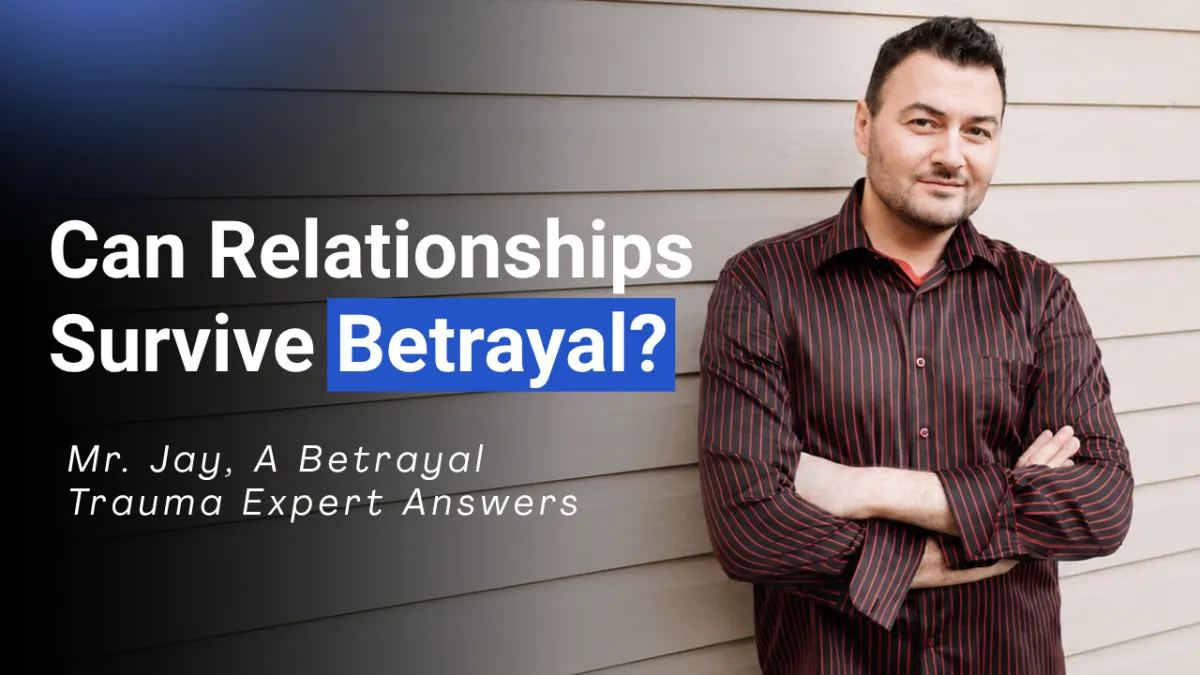
Betrayal Trauma Explained: Why Broken Trust Hurts So Much (And How to Heal). Mr. Jay & Samia Bano
Betrayal Trauma Explained: Why Broken Trust Hurts So Much (And How to Heal). Mr. Jay & Samia Bano
Why does betrayal feel like it shatters your entire world?
#BetrayalTrauma practitioner and #RelationshipCoach Mr. Jay explains why broken trust affects us so deeply, how childhood wounds amplify #emotionalpain, and the practical steps toward #healingafterinfidelity, abandonment, or emotional betrayal.
Mr. Jay shares the surprising statistics behind, why many couples actually grow stronger, and the mindset shifts necessary to #rebuildtrust, restore intimacy, and move forward together after emotional devastation.
This episode offers hope for anyone #rebuildingtrust after trauma.
Learn more and connect with Mr. Jay at:
www.MrJayRelationshipCoach.com
https://linktr.ee/traumapractitionerjay
To Book your Free HAPPINESS 101 EXPLORATION CALL with Samia, click: https://calendar.app.google/ycNkS9obhoQhiYXM6
#betrayaltrauma #betrayaltraumahealing #relationshiphealing #rebuildingtrust #trustafterbetrayal #infidelityrecovery #emotionalhealing #traumahealing #attachmenttrauma #childhoodtrauma #innerchildhealing #selftrust #healthyrelationships #relationshipadvice #mentalhealth #anxietyrecovery #depressionhealing #forgivenessjourney #boundaries #selfworth #resilience #personalgrowth #spiritualhealing #healthyrelationships #healthyrelationshiptips
Here's the audio version of this episode:
Transcript Automatically Generated
Hello, Salaam, Shalom, Namaste, Sat Sri Akal, Aloha, Holah, Ciao, Bonjour, Buna, Privet, Mabuhay, and Dzień obry…
It's really, really good to be with you all again, and I know you'll be so happy you've joined us today, or at least you'll be so glad you have joined us today, because we will be learning about some very, very important things with Mr. Jay, who is a Betrayal Trauma Practitioner. Welcome, Mr. Jay.
Thank you. Thank you. I appreciate you having me on.
We're so glad to have you on. Please tell us more about who you are and what you do.
Absolutely. I am Mr. Jay, and I am what's called a Betrayal Trauma Practitioner. So I help people, individuals, or couples, hopefully couples, because they're trying to work on betrayal, work on and come together and navigate the very difficult process to repair and rebuild after trust is broken in their relationship.
Yeah. Well, I mean, I can imagine that is very challenging, certainly for the people who have experienced betrayal, even to come to that point where they want to repair that relationship. Can you actually tell me a little bit more about what betrayal is?
And why does it affect us so much? Like, why is it so difficult for us to deal with? Yeah.
No, great question. You know, first of all, betrayal is similar to trauma in the sense that it's really not the betrayal or the trauma that affects us so much. It's the meaning that we give it.
It's the meaning that we assign it. And usually, the meaning that we give it comes from our core insecurities, which is why it's very different for everyone to be on this healing journey. A lot of people do repair and rebuild.
Statistically speaking, give or take about 75 percent of all couples, after there's a big rupture or betrayal in their relationship, can in fact heal and thrive and stay together. But there are people for various reasons. One of them could be if somebody has a profoundly traumatic childhood, and there's just too much brokenness for them to deal with, and coupled with, let's just say, they have an avoidant personality or attachment style, now let me run.
I don't want to deal with this. I can't deal with it. Don't get me wrong.
People can have a non-negotiable. Like I said, if you ever step out of the relationship, I'm done. I'm going to keep my word.
I'm done. However, it's very difficult because unfortunately, I work with a lot of couples who have been married 20, 30, 40 years. Now, they have kids and grandkids in a house together and property together, and they're nearing their retirement.
So leaving and separating is not that easy. I always say there's a big difference between reality and theory. But anyways, one of the hardest parts to get back what I was saying with betrayal and trauma or betrayal trauma is we have to un-code the meaning that we assign to it.
And that's very hard because there's a part of our brain that actually helps to attach the meaning of what happened to our identity, which is why a lot of times you'll hear, you won't hear people say, a part of me feels betrayed or a part of me was traumatized. They say, I'm traumatized. I was betrayed.
So it's very important that we dismantle a lot of these parts, which is the only way to heal. Now, I will say this, betrayal can happen in various dynamics, okay? So we could have betrayal from, we could have betrayal trauma from anyone that we depend on.
There has to be a reliance or a dependency upon. So, for instance, if you see a car accident, you're not going to experience betrayal trauma because you weren't depending on that car, you weren't reliant upon that car. But if you experience like your family member betraying you, if you experience your job, your boss betraying you, you depend on your job, you depend on your boss, your children, your parents and most certainly your significant other, your spouse, your partner, your loved one.
Now, you can also experience betrayal trauma from yourself. So, let's just say you eat healthy and you pray and you meditate and you do all this, but you were still diagnosed with breast cancer or something, you can feel like, jeez, my creator betrayed me or my body betrayed me. So betrayal trauma is very complex, it's very multi-layered, it's very nuanced, and it's different for every person.
Yeah. Oh. Thank you for framing that for us, because it sort of helps me to see the broader, to see from a broader lens what betrayal actually can be.
Because a lot of times we think of it in a very narrow fashion of, oh, somebody or like my partner cheated on me, you know, like, and you think about it in a fairly narrow way. And what you're highlighting is that not actually can happen in many different contexts. And a lot of it, so you're saying, is also about our expectations.
Like, what do we expect?
Or if we have a dependence on the other. And so if you didn't have the same expectations, if you didn't have the same kind of dependence, then you wouldn't experience the same kind of ritual trauma.
Yeah, there's a school of thought out there that trauma happens in between expectation and what happened, the event. And so, there's a big disconnect there. Now, you might be thinking or people might be thinking, well, wait a minute, when you're in a relationship, there's unwritten rules that everybody follows.
You shouldn't have, I mean, this shouldn't have to be an expectation. It's an unwritten rule. Well, yeah, but then you get into, I always say when we are experiencing a betrayal from a loved one, and I don't want to trigger you or any listeners, but it's almost like when you're in a concentration camp.
You can sit there and say, I shouldn't be here, this is unfair, how did I wind up here? It's, you know, life sucks. How is that going to help you?
So really, when we're betrayed, the question should be, okay, what now? Now, we start with what do I need? What do I need to keep safe?
What do I need to feel like I'm safe? Whatever, because that's what we want to do. Then if you're going to rebuild and repair, one of the questions you might want to ask yourself is not why did they do that to me, but what happened to them that made them capable of doing that to themselves, and then I was innocent victim of that.
I want to tell you something, that we got to be very careful, very careful because the first thing we ask ourselves when somebody betrays us, how could you do that to me? You have to think, though, the first betrayal was them betraying themselves. Now, just like a volcano, when the lava erupts, it's going to affect and kill everything it touches.
When their life erupts, also known as we find out they were unfaithful, that lava is going to touch us, but we can't own what they did. They combusted, we're the innocent victim that got hit. Because what, you know what I hear a lot?
Was I ugly? Was I foolish? Was I stupid?
Was I, no, no, you believed in love and you were living. They had some issues, some trauma, some things in development, childhood, and their coping mechanisms were very weak. So they did this to themselves.
You just happened to be an innocent bystander who now are as a victim.
Well, that's interesting.
So, wow, you just went to a perspective that, like, for example, when in my practice, we talk about the idea of forgiveness, I mean, this is actually a core aspect of what we have to work on as well. First of all, you know, this whole separate, like, not taking responsibility for other people's actions, but also to try and do it from a place of not losing empathy and compassion, and not just not losing empathy and compassion, but actively cultivating empathy and compassion for them, and this question of what happened to them that led them down that path. I mean, so in that question, there is a certain evaluation, if I might use that word, that there is something in what they did that was hurtful or inappropriate in some way.
And yet we're trying to understand that from a more empathetic and compassionate perspective.
Yes. And listen, we don't do this to give them a free pass. We don't do this to excuse their behavior.
We don't do this to rationalize or trust their behavior because it was horrific and disgusting and abhorrent, vile, and dirty.
Yeah.
But what we want is we want for our own system to understand things because it's in the understanding that's one of the components of the Foundation for Healing, one of the many components, you know.
Yeah. Yeah.
Because if not, then what happens is we just internalize it and put self-blame. And yes, we loop that in our head and that causes us trauma or additional trauma. Because I always say other people give us pain, we give ourselves suffering.
Right. Yes. I agree with you on that.
There is a saying along those lines that pain is inevitable but suffering is optional. And the first time that I heard that, there was first of all, it just stuck in my mind. And at first, I didn't know if I wanted to believe that to be true.
Because when I felt myself suffering, and I didn't feel or think that I could stop my suffering, that I could choose not to suffer, then I didn't want to believe that it was something that was optional. I was like, no, this is not optional for me. It's just something that I'm suffering, and I didn't choose this.
So I didn't want to believe even in the possibility. But at the same time, there was another part of me that actually really wanted to have that be true. Because if it was true, then there was some hope, I thought, for me being able to choose not to suffer.
And so I definitely had this sort of like inner conflict going on. And I'm so glad that I found that, oh gosh, it is true.
Yeah, you know, here's the deal. Obviously, when we are hurt, we are, we, we are, we are affected. And, and our inner child is saddened and wants to be seen and wants to be heard.
And what do children do when they're upset and sad and hurt? They scream and they shout and they tantrum. Well, you know, we're adults, we can't really do that.
I mean, we're all tall children, if you want to be honest with you. So we do want to be acknowledged. We do want our hurt to be validated.
And here's the deal, if we tell ourselves, listen, they gave us pain, but it's up to me to deal with my suffering, then that puts the responsibility back on us. And we don't want responsibility, we want validation. So, you know, when we are hurt initially, we are allowed a period to be miserable, to be hurt, to be in pain, to cry, to scream, to do all that stuff, absolutely.
And actually we can do it for the rest of our lives, if we want, but that doesn't help us heal.
Yeah.
One of the things that's really frustrating is that when we are traumatized or betrayed by somebody that we cared for and loved and depended on, they gave us a full-time job that we never applied for. So it's not like, okay, you hurt me, now you have a lot of work to do. Well, they do have a lot of work to do.
They have a lot of work to do consistently for a long time. However, you do too. Because listen, if I get in my car right now and I run you over, you can say, Mr. Jay, you need to repair what you did.
I can spend months and years apologizing, telling you I regret what I did, bringing you coffee in the morning, rubbing your feet. I can do all kinds of it. But if you want to walk again, you're going to have to go to physical therapy.
You're going to have to remember to take your medication. You're going to have to have the willingness. So that's what betrayal trauma does, is it gives you a job you never applied for.
One, I mean, is there like some kind of context within which you would draw a line in terms of healing, in terms of reconciliation in the relationship, not only can happen, but that would be a helpful thing to pursue, versus there may be a context where it's like trying to reconcile, to give healing the meaning of reconciliation, to be like a no-go, like, or that wouldn't be really helpful in reality.
Well, if I understand your question correctly, I think, actually I know, there is no, there are no circumstances that can prevent a couple from repairing and rebuilding if both parties want to and are willing.
Yeah.
How, with the exception of, like, ongoing consistent abuse or repeated acts of betrayal, I mean, you know, then you need to say, you know what, I love you, but for my own sanity and healing, I have to go. Because I've worked with people that have been pregnant and lost their child because of a betrayal. I've worked with people who have profoundly lost all their hair from the stress of the, the stress of betrayal, trauma, if it's unhealed.
And I want to use that word cautiously because I don't know if you could ever fully heal from trauma or betrayal. And I know that might be a surprise to a lot of people, but here's the deal. Because so much of trauma and betrayal is grief, I don't think we ever heal from grief.
We incorporate it and we learn how to manage it. I don't know if we ever get over it. So, I don't know if you can ever get over trauma, but you could certainly incorporate it and learn skills to manage it before it manages you.
You know? But at the same token, I've worked with couples. As a matter of fact, I worked with one couple.
They've been married 38 years. Husband and wife, couple. And the wife said, my non-negotiable was porn.
My non-negotiable was porn. I caught him watching porn. They're going through a divorce now.
That's it. That was her non-negotiable. But I also worked with plenty of couples where one of them had an affair, one of them had a sex addiction and slept with over 200 people, one of them had a 12-year affair, one of them, the partner broke into the wife's house, poured gasoline on her and lit her on fire.
But in all of these scenarios, the couples are still together, they're working and they're doing wonderfully. So to answer your question, it's not the situation that keeps people apart. It's the willingness and determination and the work that's put in, that will keep a couple together.
Yeah, I mean, definitely the willingness on both sides, but I can see as being extremely, extremely crucial. I mean, you cannot, I mean, no kind of intervention or therapy or any attempts to keep two people together can work if both people don't want to be together. But I was wanting you to dig a little bit deeper with us into if you did mention that if there's abuse, especially if it's like ongoing abuse or like the betrayal is happening repeatedly, that those could be conditions in which this kind of healing becomes difficult or so forth.
So, I mean, I have more familiarity in the context of abusive relationships because I've actually trained as a crisis counselor and I worked for four years in the domestic violence hotline. And so, you know, we, in our work, this was like something we said, you know, like couples therapy certainly doesn't work in an abusive relationship. Is that what we worked on?
Because in an abusive relationship, one of the partners is on an agenda to control the other. I mean, that is part of the core essence of what abuse is, that you are trying to control the other person. And so if you're on an agenda to control your partner, then you are not really going to be willing to do what it takes to be in a really healthy relationship, which requires a certain amount of caring for each other, of giving each other space, of sometimes compromising, of having empathy and compassion for each other and so forth.
And so, in theory, I think that's all very well, but you just gave some examples of the situations that couples had experienced, and they still are together. For example, the example where you said somebody, one partner poured gasoline, and...
No, no, no, the person's affair partner broke into...
Oh, oh my God, oh...
.poured gasoline on the wife.
Oh, shucks. Yeah, yeah, yeah. That, oh my gosh.
That is so harsh.
Yeah.
Ah, okay. And in the, and you also mentioned cases where somebody had a spec prediction, and they were like repeatedly engaging in like many different relationships. So in that kind of a case, I mean, or in context like that, it's…
I mean, do you first, does the partner who has the challenge of like let's say the sex addiction or something, do they first do work on themselves to a certain extent before you're able to work with them in a context of working on the relationship with their partner? Or like, what does that look like? Or how does healing… I mean, because there's, well, I mean, healing is also so multilayered, but there's like also multiple people involved in cases like this.
So yeah. Well, two things I just want to say. With the couple, with the example where it was a male-female couple, in the male, it was the sex addict, and he stepped out with the course of their marriage and slept with over 200 different people.
Once she discovered it, brought it to his attention and their life blew up, he stopped his behavior. Because if he didn't stop his behavior, I probably would have recommended initially the therapeutic separation and then we would have went from there.
Personally speaking, I like to work with couples congruently. I think that betrayal, although it's a personal issue, it affects the relationship and I think whatever affects the relationship needs relationship healing. So I like to work with both the couple from the get.
The other reason is when a couple is together and both of them decided we want to be together, we are committed, we're going to do this together, then I think it's important for both parties to even hear and listen to the struggles, even the personal ones of the other person because now they're one, even though they're a couple, they're one. If he's having a hard time with, I don't care if it's from medication to dreams to temptations to triggers, she needs whoever he's in a relationship with, male, female, they need to hear both of them so they can be on the same page. Absolutely.
By the way, when I talk about abuse, especially physical abuse, what I mean primarily, and I probably should have made this more clear, is that in probably almost every case where I talk to a couple, where one discovered their spouse was unfaithful, the person who was betrayed has probably physically aggressed towards them. For instance, I'm going to give you an example. Let's take a male-female couple, okay, and she just discovered he was hiring prostitutes for eight years while they were married.
Now she's fixing her bed one time and she finds numbers under her mattress and she goes to call them and it's escort service. Well, you have to understand, her world just collapsed under her, which her foundation, her safety, her stability, her future, her life flashed before her eyes. Her mind is hijacked.
So if he comes to me and says, Mr. Jay, she was talking to me and she slapped me across my face. I don't know if I consider that abuse. I'm going to be honest with you.
That's a physical response to somebody feeling unsafe. Now, if five years later, she's still slapping him in the face, okay, that's abuse and we probably are not good together. Now, you're going to have different people listening to this and completely disagreeing with what I'm saying, but that's fine.
That's my professional opinion. People react physically from a... I mean, listen, if you take a wild animal and you corner it, what's it going to do?
It's going to claw, scratch, bite, whatever it takes because it feels unsafe. I don't like physical aggression. I wish people wouldn't do it, but they do it.
It happens.
Yeah.
And I'm not going to call that abuse.
Yeah. I mean, in the context of my learning, we made a distinction as well because, for example, in the law, there is the idea of the primary aggressor. So for example, if the police get called, let's say neighbors hear a couple fighting, they get concerned, they call the police, the police come, and let's say there has been some physical violence where one person hit, but another person also hit, or threw something at each other, or let's say on the surface, it seems like both people were fighting physically with each other, but actually one of the goals, if the police do their job right, which they don't always, but the law is that part of your investigation is to determine the context within which that violence was taking place, and if there is, if you can determine that one of the parties is a, or is the primary aggressor, meaning that, you know, one person could have been, they're the dominant force in the situation, and the other person, even if they did act in a physically violent way, it was in self-defense.
It was a reaction to, you know, the aggression that was being, you know, directed towards them. And so we all have the right to self-defense, and that is actually recognized in the law. And so that is part of what, like, police in this kind of scenario are supposed to evaluate the situation for and take into consideration.
And similarly, if the case was to go to court, you know, this would be something that would come up. And this is also, like, something that comes up as an issue where, like, racism and other sort of biases can creep in. Where we have to, like, as, because we, on The Crisis Hotline, we're also trained to be advocates, and we often can be called to, you know, advocate on behalf of the victim, or rather survivors of abuse.
They, you know, often, like, for example, there is this image of Black women, and it's very, you know, problematic, where, you know, they're, I mean, they're, where it's like, oh, the strong Black woman, and she's so loud, and she's so, you know, aggressive, and this and that. And so it's like, oh, of course, that she, you know, because she is like that. Beautiful people that make all these kinds of assumptions, and assume her to be guilty of abusive behavior, of, you know, because they just label her as, oh, she's loud, she's aggressive, she's just like that.
And so then, you know, you're not willing to take into consideration, hey, what's happened to her that that hurts her to the head.
Yeah, no, absolutely. I'm a big, yeah, no, I, obviously, we still live in a culture where, you know, we're dealing with racism, gay-cism, sexism, all the isms. And obviously, there's no excuse, no matter what somebody has been through for the most part.
But I will go back to what I was saying before. In my professional opinion, cheating is abusive. Because you're robbing somebody of consent.
You are stealing somebody's ability to make independent decisions for themselves. I think also abandonment is a form of abuse. Neglect is a form of abuse.
And these are all things that you're doing while you're cheating. So again, I don't like it when people physically act out. I wish it didn't.
But I can understand when somebody is unsafe, cornered and they're completely fearing for their life in the moment and their mind was hijacked, they do physically act out. Now, on a side note, just between you and I and whoever's listening or going to listen, it gets very tough when I'm in session and I see anything because obviously there's reporting that has to be done and stuff like that. So I make it very clear, please, no matter how angry you get, could sit on your hands when you're talking in session, do not lash out.
But there's a lot of things we have to take into consideration with this because betrayal trauma hits us at our core insecurities. And we have core insecurities that have been with us for years and decades. And they, when we get betrayed, it's like that sleeping giant within us awakes and we go for the jugular.
It's a lot of healing work. It's a lot of healing work. But I'll tell you something.
Like I said, give or take, about 75 percent of all relationships not only survive, actually thrive.
And people can really have... I tell people all the time, you might have lost your happily ever after, but you can still have your happily even after if you do work. But it's a lot of work.
Yeah. Can you actually share some examples of the kind of insecurities that we may have that in the face of betrayal, like you said, they're rare up and well, what are some of these, maybe one or two examples?
Yeah. Well, listen, I will, but first, let me ask you a question.
Yeah.
Have you ever been dating somebody, or if not you particularly, maybe somebody who will listen to this, what happens after we're dating somebody and then we get dumped and we find out they're dating somebody else? The first thing we think of, we think of, oh, they're in a hammock and they're rocking and they're laughing and tickling each other and telling each other jokes and feeding each other grapes and looking at each other deep in the eyes and get, these are all our insecurities. That's not reality.
It's the same thing when we discover there's a betrayal, one of the first things we do is, oh my God, I wasn't lovable. I'm not significant enough. I'm not pretty enough.
I'm not worthy enough. I'm not, and so these are the insecurities. And what happens is we wanna protect those insecurities because those insecurities are our inner child.
Our adult self wants to protect those insecurities. So what do we do? You cheated on me?
Who do you think you are? And then the monster comes out in us. So that's what I mean.
We wanna protect it. And this is where, and I'll tell you, I get a lot of people that call me and they'll be like, Mr. Jay, I just don't feel anger. I feel rage.
I am enraged. And I'm the monster I never thought I was capable of. Well, obviously, because you're tapping into parts of you that haven't ever been tapped into before.
And your inner child that was never healed is screaming now and now, so many parts of you from your ego to your adult self to your, what is now saying, oh, you will not disrespect my inner child. So it's very complex. Like I said, it's very nuanced and there's a lot of work to be done.
As a matter of fact, real quick, sorry to interrupt. I always say when we go through betrayal trauma, only a part of it is the pain that we're currently dealing with. We really have to go back to the original trauma that we experienced.
That's what we need to do.
Yeah. Yeah. You know, you're making things so I've never dated.
So I could not relate to that particular example at a personal level, but I was thinking about context within which I have felt betrayed. And, well, there is a number of different examples that came to mind. And like thinking about which one I would like to highlight in this moment.
It made me also think about what we were saying earlier about how a lot of the trauma is related to the expectations that we have and that are broken. And that you recognize betrayal as a form of abuse. So, these thoughts in my head were swirling.
And I think what's coming up the most for me in terms of an example is my biggest trauma that I've experienced and that I identify as the biggest trauma is actually child sexual abuse. And so, for me, in the context of that experience, like one of the most devastating things was the breaking of expectations in the sense of like, the person who abused me is someone that was like a member of my extended family, right? And so, they were someone that I unquestionably trusted, that everyone in my family trusted to be part of that circle of love and protection for me.
And so, you know, it's like, it was an expectation absolutely that I had, that this person would love me and do it in the most appropriate ways, and help keep me safe and so forth. And like certainly, you know, I think the reason, one of the reasons why I'm bringing up this example is, you know, like now it's very, as an adult who has done a lot of healing work, you know, it's very clear for me to see that there is no way that I could be guilty of anything that would have been right or made me deserve abuse. Nonetheless, I actually did develop a lot of shame and guilt in the aftermath of going through that experience.
So like when you talk about the insecurities that, you know, rare up and, you know, create all this trauma for us, I can very much relate to that idea. And it's sort of like the... So not only did the insecurities come up, but there is also this, I'm not sure if I can, I hope I can verbalize the question coming to me.
There's also this expectation piece that I think I want to dig deeper into because it's like the expectations that we form in our relationships. They're oftentimes very valid expectations. They're very, like even, not even just like, oh, it's an unwritten rule, but it's like, they're actually explicitly stated rules, you know, of our social contracts, you know, of the relationships that make up our societies and families and stuff that, hey, you know, like, I mean, like a husband and wife literally swear to be faithful to each other, you know, and certainly an adult caregiver, a parent, like literally responsible to protect their child and so forth.
So like, the part of the trauma that's related to broken expectations. I mean, the insecure, it's like, it's so, like, yeah, what do you do? I mean, if it's an insecurity, like I took on blame and shame that is based on, let's say, thinking that is not accurate.
But the expectation part was certainly something that was justified. The fact that I had those expectations, there is a validity to it, and a very solid foundation to why I had those expectations. So, I'm not sure if I'm still able to verbalize quite well, but you know, like, how do you, like, what do you begin to do in terms of how you think about what happened, where these expectations are broken, that are very valid and grounded in some strong foundation and reality and so forth.
So, how do you begin to rethink or reframe that in the context of the healing process? I think that's my question.
Yeah. If I understand your question completely, when we are a child, our logic, our thinking, our expectations are very different because we don't understand that the world can be cruel, can be violating. And so, our concept is different.
Now, when we're an adult, obviously, it's almost like we put a different pair of glasses on. Oh, wow. The world does have a capacity, including people in my inner circle, to make these wrong choices.
And, you know, which is why I say, when we are at a point where we understand the difference, trusting, we have to reframe it to this. Again, when we're an adult.
Yes.
I am not going to put my trust in some person outside of me because I'm not going to put my trust in the person who may have lack of coping mechanisms, lack of maturity, lack of, you know, like, you know, I'm not going to put my trust in the potential random choices, decisions and behavior of somebody. I have to put my trust that if they make decisions to hurt me, I'm going to be okay.
Yes.
I'm going to trust that myself, that I'm going to be okay. The problem, however, is that when we are abused, when we are violated, when we are betrayed, when we are traumatized, we detach from ourself. And it takes a lot of work to get to know who we are.
Our non-negotiables are, you know, heal all those things. So we can have that trust within ourselves to say, okay, you know what? I understand everybody's human, everybody's family.
For various reasons, people can make horrible, disgusting wrong choices. And in the case of, I'll go back to my field, infidelity, I always say affairs are a thousand, it starts with a thousand justifications. I'm just going to look at her picture.
I'm just going to stare at her picture. I'm just going to like her picture. I'm just going to comment on her picture.
I'm just going to send her a DM and say, I like your bikini. I'm just going to respond to her, a thousand justifications. See, you should have never, first of all.
But so now what we have to do is people are failable. People are human. We want to trust them.
We should be able to. We tell them our expectations. We tell them our boundaries.
My trust no longer can be in the potential future behavior of what you do. My trust is I'm going to be all right and okay, decide.
Yeah, that, thank you for that. It's also, it's helping me realize that it's interesting that you said that my trust has to be in that, that I will be all right, because, you know, there are these aspects, like, what am I trusting? Like, if I say, okay, I'm going to trust myself, what am I trusting about myself?
Because, as you had also mentioned in the example earlier, we can also betray ourselves, you know? And so, like, what can I actually trust myself on that I can actually have be true, that I can live up to? Because that in itself can then become an issue where, you know, you have self-limiting beliefs and this and that, that can then prevent you from the healing, engaging in the healing that you need, because, you know?
I'm going to be honest with you, as cheesy as this may sound, I think that you have to believe and trust that you will simply never give up on yourself. You might be down on yourself, you might be, you know, go through a chapter or a period where you're insecure, where you're feeling down in the outs, where you're depressed, whatever, but I will make a vow that I will never give up on myself.
Yeah, I mean, and that is a choice that we can make. And thankfully, that is a very, very strong instinct that we have. I mean, there are situations and contexts where even that can fail us.
I mean, there are people who commit suicide, for example, because even that becomes too much of an expectation for them to hold on to.
But yeah, overall, I think we have a very, very strong instinct to want to continue to live, to survive. So that is a good, that's a good something for us to vow to do for ourselves.
And listen, and at the same token, I think endless mercy, endless grace, understanding. Life can be very long. You know, whatever takes 75 years on this planet, I'm a little less, I'm a little more, whatever.
You're going to go through periods where you let yourself down. You're gonna go through periods where you disappoint yourself. You're gonna go through periods where you fail yourself.
But that, but, but then, but understand that even within those disappointments and failures, you know what? I might be down for it for the time, but I promise I'm not going to stay down. Yeah, I might, I might feel depressed.
I might be experiencing depression right now, doing what I can to, but I promise I'm gonna do all I can to get out of this.
Yes, and when we are able to learn to do that for ourselves, it becomes, I think, easier to do it for others. So like this, just as I can see for myself and give myself the grace and mercy of Eliza Kay, there will be time when I will fall short, when I'll do something maybe even horribly wrong and disappoint myself, break trust with myself, but I will not give up on myself. I will, you know, and to believe that I have the capacity to actually rise up again and do more and do better.
If I can believe that about myself, then it becomes, I think, more possible for me to believe that about somebody else.
Absolutely. Listen, you cannot pour from an empty cup. So the more you have inside you, the more you can pour into others.
And let me just be clear too, if there's anybody that is going to listen to this that has ever felt suicidal or knows family or friends or whomever that have done that, I don't think that's a weakness at all. I think somebody's coping mechanisms were so overwhelmed that, because I always say people don't necessarily want to die. People want the pain to go away.
Yeah.
Just this is their way currently. They felt no other option than to make the pain go away. So I don't look at people that are suicidal as a weakness.
I mean, unless it's those people that every other day, they're like, oh, I hate my life. I'm going to kill myself. It's okay.
That's, you know, whatever. That's a whole, not talking about those people.
Yeah, it's interesting. I mean, you know, when, I mean, there's different contexts when rich people are driven to suicide. I only have very personal experience in the context of experiencing deep depression.
And in that context, yes, definitely the big thing was, I just don't want to feel the pain or rather the suffering anymore, because I was not in physical pain, but like mentally, emotionally, I was suffering. But there is also, depression does this, you know, like, or it can, where, like, you lose your sense of meaning and purpose. And it's like, why even go on?
It's like, what's the point of life? What? It's like, and so I think that was also the, other than wanting the suffering then, there was that loss of meaning that was almost more challenging, because it's like, if there was something meaningful enough in my life to make the suffering, like to, it's like, okay, I will bear the suffering or the spin because I have this purpose that feels meaningful.
Like, you know, I often think of someone like my mom or any mother, for that example, in that context, like a lot of mothers, they're on a mission, right? They're going to, they need to protect their children, they need to make sure their children are okay. And this is something I've heard my mom certainly verbalize, but other moms as well, where, you know, she went through a lot of difficult times in her life where, you know, there was violence, literal violence in the community erupted, and people's lives were in danger.
And my mom's thought was, well, I have to keep my kids safe. And so that also meant she had to keep herself safe because she was like, if something, she literally, she says she had this thought, like, if something happens to me, who's going to take care of my children? And so she had this, like, really strong motivation to want to live because, you know, she had this purpose to her life of protecting her children, that she was willing to die for, by the way.
So, but like, when I was in deep depression, I lost any, like, I lost sense of purpose and meaning. I was like, I don't see anything worth living for. So that was for me, like, I think most challenging to come out of.
Yeah, you know, it's depression. I mean, obviously, it runs the spectrum. There's clinical depression and then, you know, it literally feels like everywhere you go 24-7, there's a very dark cloud over you even when you're sleeping.
Like, you're depressed in your sleep.
Yeah.
You wait and it's... But when you're in the... When you're in it, you can't really see much.
But I always say, you know, depression is... Your mind is too much on the past.
Anxiety is when your mind is too much on the future.
Yeah.
But I'm gonna tell you something. For anyone that will listen to this, that's struggling with depression, absolutely, it's very hard to find purpose. One of the things that I try to urge people to do is, as sucky as it is, embrace the fact that your current suffering is your purpose.
Tell me more about that. How does my current suffering, how can that be my purpose?
Because listen, I say it all the time. We don't find our purpose in life from our passion. Like a lot of people are like, you know, I want to be a teacher because I love kids, you know, maybe when we find our purpose from our pain.
That's true purpose. So if you are going through a depression, and Lord knows, depression sucks. It sucks, you know?
It's like, I mean, you know, just for anybody listening for relatability purposes, nothing brings you joy. And if it doesn't, it's extremely temporary, and it only makes a blip on the radar. And you think, okay, wait a minute, what did I do before that brought me joy?
What are my guilty pleasures that bring me joy? And you think, and you're like, that wouldn't bring me joy anymore. Before, I loved spending time with animals.
Do I want to do that now? No, just, no, no. Before, I loved watching these shows.
I could care less. Nothing, so what, so one of the things, and you know, is to just try, you know something, I gotta sit in the sock. My purpose is to experience this sock, because it's going to help me, my springboard to walk into my purpose.
If I can with this, stick it through.
Yes. Mr. Jay, I want to just keep on talking with you, and I've already used up more of your time than I had asked of you, so I'm so sorry I'm going to have to start to wrap up for right now, but do you have any last words to share with us?
So I just want to say this, and I'm going to circle back to what I said before. Listen, I told you before, other people give us pain, we give ourselves suffering, right?
In the history of mankind, womankind, whatever, no one has ever died from a snake bite. So hear me out. In the history of mankind, nobody's ever died from a snake bite, never.
What people die from is the venom that gets into your vein, that leads to your heart and affects and stops your heart.
Yeah.
So people will bite us. People are going to bite us. We have to ensure their venom doesn't reach our heart.
People are going to give us pain, we give ourselves suffering. Don't loop and loop and loop and loop and ask why? And why wasn't I good enough?
And not this and why? No, they gave us pain. They gave us venom.
Stop that and it's tracks. Don't let it get to your heart and soul.
Yeah. Oh, thank you so much. I absolutely love that analogy.
Oh, thank you so much. I'm going to resist making any further comments except to remind our listeners, or if you're watching, you know, audience, to please make sure you check the show notes because we will be dropping Mr. Jay's links in there so you can connect with him and continue to learn with him. And until we connect next time, I just wish you lots and lots of peace and joy.
Thank you.

Want to check out even more amazing episodes?
All of our episodes are archived on our vlog page :)





OUR PEACE OF MIND GUARANTEE
Because we’re committed to doing onto others what we would have them do onto us, all our programs come with a Peace of Mind Guarantee.
We know you’re going to love our programs. We’re so confident about the quality of our programs we’ll give you full access risk-free for 30 days. If you decide the course isn’t right for you, then you may request a full refund up to 30 days after your purchase.
Copyright © 2018 Academy Of Thriving