
Blog: Make Change Fun And Easy
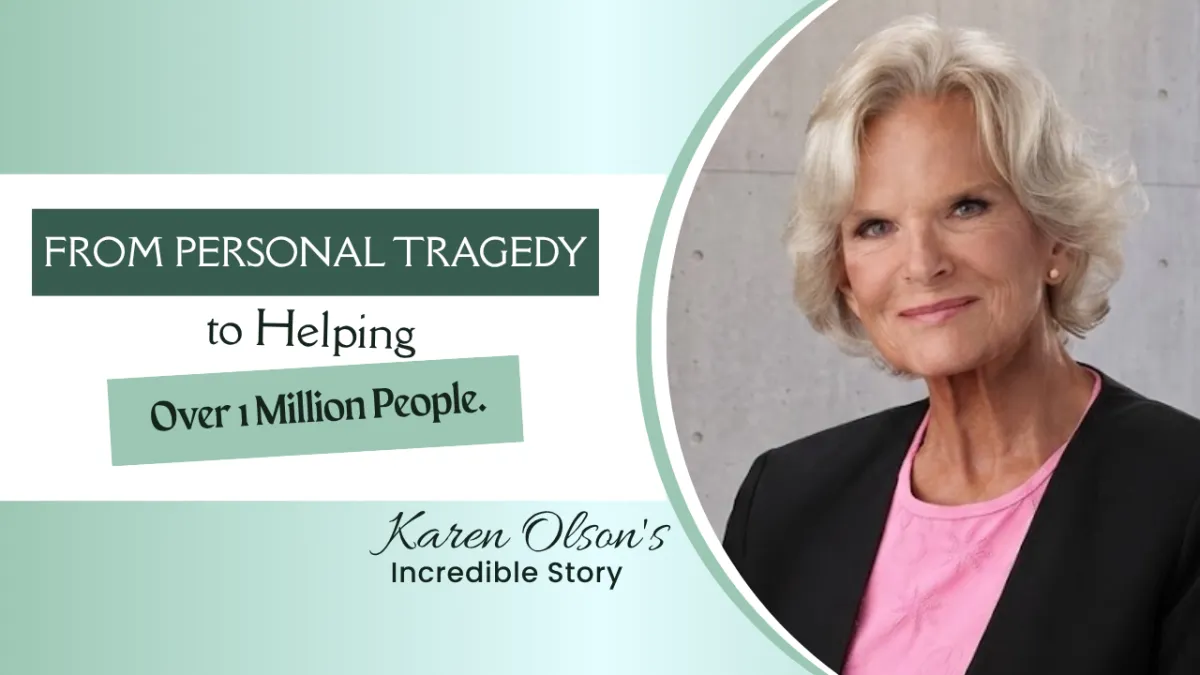
Finding the silver lining in pain. Karen Olson & Samia Bano
Finding the silver lining in pain. Karen Olson & Samia Bano
Can life's greatest pain become your greatest #purpose?
Listen now to Karen Olson's #incrediblestory. It is a testament to the power of #resilience.
Karen Olson faced devastating personal loss, career setbacks, and a life-changing accident. Yet through every challenge, she found purpose in #servingothers.
Learn how she founded and grew Family Promise, a national #nonprofitorganization that helps #homeless and low-income families. Family Promise has already helped over one million people find #hope, #housing, and a #newbeginning!
This conversation is filled with wisdom, inspiration, and offers guidance for anyone searching for purpose.
Karen has written her story in her #memoir, "Meant for More." Check it out at: https://prbythebook.com/experts/karen-olson/
Learn more about Family Promise at: https://familypromise.org/
To Book your Free HAPPINESS 101 EXPLORATION CALL with Samia, click: https://calendar.app.google/ycNkS9obhoQhiYXM6
#findingthesilverlining #silverlining #FamilyPromise #EndHomelessness #FamilyHomelessness #HomelessnessAwareness #InspiringStories #PurposeDrivenLife #Compassion #KindnessMatters #OvercomingAdversity #NonprofitLeadership #SocialImpact #Volunteer #CommunitySupport #GivingBack #MentalHealthAwareness #LifePurpose #InspirationalPodcast #MotivationalInterview #ChangeTheWorld #Humanity #ActsOfKindness #PodcastEpisode #servinghumanity #servingthecommunity #nonprofitleadership #lowincomesupport #unhoused #homelessness #helphomeless
Here's the audio version of this episode:
Transcript Automatically Generated
SAMIA: Hello, Salaam, Shalom, Namaste, Sat Sri Akal, Aloha, Holah, Ciao, Bonjour, Buna, Privet, Mabuhay, and Dzień Dobry…
It's really, really good to be with you all, and I know you'll be so glad and happy that you have joined us today, because we have a very special guest with us, and that is Karen Olson, who's the founder and CEO Emeritus of Family Promise. That is a national organization that has helped a million men, women, and children.
I'm so glad, so happy to have you with us, Karen. Welcome.
KAREN: I'm so happy to be here. Thank you for having me.
SAMIA: Yes, it's our pleasure to have you with us. And please, Karen, tell us more about who you are and what you do.
KAREN: Well, my life has taken so many twists and turns. At the time, I thought it was not for the better, but each step I took where there seemed to be a block, it really shadowed a wonderful event that changed my life. And no one could say, if your mother died, that that would make a difference.
But my mother, I had a very happy childhood, carefree, playing out until dark. I was swimming in Long Island Sound, skating at the pond at the end of my road. This was when I was young.
But when I was 12, I suffered an unimaginable, tragic loss. My mother committed suicide. And that left a hole in my heart.
At night, I would cling to a stuffed cat, toy cat that was given to me by one of my father's friends. I called him Mike the Cat. That was my only security, you know.
At that time, it's a little different now because there's a lot of grief programs, but no one talked about death after. It was like it never happened. And it made me very, very sad, of course.
But, you know, life went on. And I found that, you know, when my mother was alive, I wanted to be a famous ice skater or swimmer. But now, I changed and I wanted to do things that would help people.
I began volunteering at a hospital nearby, and I enjoyed talking to the patients. There was a boy who lived across the street from me who was dying of cancer. And his girlfriend left him.
And I played tennis with him. So, I became more truly aware of people's needs. And I would respond and help them.
Then, when I went to high school, I knew I wanted to become a nurse. That was going to be my way of helping. But I had a stepmother who was a nurse.
And she said to me, Karen, you'll never be a nurse. You just don't have what it takes to be a nurse. And she persuaded my father not to send me to nursing school.
So, just like that, my dream was shattered. And that was very, very difficult for me. But I pivoted my career.
And I studied business administration. And I got a job later with the Warner Lambert Company. And I was a consumer promotions manager in charge of developing sweepstakes and couponing events for products like chick razors and blistering metal bars.
And while I enjoyed working with my colleagues, I enjoyed the creative nature of my work. I was not satisfied. I felt that I was meant for more.
And one day, fate intervened. I was on my way to a meeting in New York City, and I was about to pass this woman who sat on a crate outside of Grand Central Station. And, you know, my grandmother had always said to me, don't go near people who are like that.
They're bums. They're derelicts. And I saw this homeless woman, and I had seen her before.
She was elderly. She was probably in her 70s. She had raggedy hair with a cap pulled over it.
But on Impulses Day, I couldn't just pass by her. I had seen her before. So I ran across the street and into a store, and I bought her a ham and cheese sandwich and an orange juice.
And when I came back and gave it to her, she said, thank you. God bless you. I haven't eaten since yesterday.
And she took my hand, a rough callus hand. She took my hand and hers. And at that moment, I know I had crossed an invisible line.
And I learned her name. Her name was Millie. And that evening, I told my two sons about Millie.
And they were just then 10 and 12. And they had the open hearts of children. And they said, Mom, let's go find more people like Millie.
And so we did, we made 75 sandwiches. And we distributed them in Central Park on our roller skates and the backpack.
And, but then we wanted to do more. And we learned that most people who were homeless gathered in Port Authority Bus Terminal. So we went in the next Sunday and brought in 100 sandwiches and gave them out.
And we learned people's names, Arthur, Lucille, Kate, Matthew. And these were not homeless people, these were people who were suffering. And the sandwich that we brought them was our way of saying we cared and we wanted to make a difference in their life.
And we got to know these people, and they waited for us on Sunday and would say, we hope we see you. So we did this for almost two years, every other Sunday. And anybody essentially, on Sunday evening, if they were sitting on a bench, they weren't waiting for their bus.
It was simply homeless. And that's something that I just couldn't get through my head, you know, how we treat people. And so I continued to deliver sandwiches.
And then it was almost Thanksgiving time. And I thought, wouldn't it be nice to invite some of the people we know back to my house? Like Lucille, who lived under an escalator with her two, with her cats.
And she said she was a school teacher, a first grade school teacher. And she would say to my son, Doug, now you study hard, Doug. You don't want to end up homeless like me.
And then there was Arthur, who was a World War II veteran who had medals pinned in the inside of his jacket. And he would tell war stories to my sons. So, these weren't homeless people.
These were our friends. And I thought, why not invite them to my house for Thanksgiving dinner? Of course, I didn't fully think it out because I never cooked a Thanksgiving dinner.
But this is something I wanted to do. So, they came and neighbors helped. One neighbor cooked a turkey, others cooked side dishes.
It was just wonderful to see everybody gather around the table. And we shared stories of Thanksgiving's past. It was just a wonderful time when we really cared about one another.
And that Thanksgiving dinner was really wonderful. Then I decided I should do something locally as well in my own community. So I started to volunteer at shelters and soup kitchens and near my home.
And there I was surprised. I met people who were experiencing homelessness, but they were that people who were experiencing homelessness. But nobody would know they were homeless if they walked down the street.
Because these were families, families with children. And at the time, the number one reason kids were taken from their parents and placed in foster care was not abuse or neglect. It was simply homelessness.
And I thought, I wonder, you know, today, one out of 30 children are homeless. And you don't tend to see homeless families because they're not living on the streets. They're able to double or triple up with friends or family members.
So you don't label them as homeless. But they are. And you wouldn't notice them if, say, a mother was walking around the street with her eight-year-old by her side and a baby in a stroller.
I thought that she was, that she was homeless. And I thought, wow, my first thought was, does a religious community know about family homelessness? Because we lived in a suburb of New York City and they would see people who were chronically homeless on the streets.
But did they know about homeless families? And if they knew about them, would they want to do something? And so I invited that religious community to a conference that I planned for family homelessness.
And I invited all different faiths. And I expected about 100 people to come to this all-day conference. But actually 200 people came.
And that told me right there that people were compared. People cared. That told me right there that people cared and wanted to make difference.
And so at the end of the conference, I organized a conference, but I didn't speak. The only thing I said was at the end, you know, if we stay together and we work together, people like Wendy will have a home. That was a man who became homeless and lived in the suburbs.
And I told a little bit of that story. And I asked them how many of you would be willing to come to the follow-up meeting to see how we could help. And every hand went up.
And I thought, wow, people really do care and want to make a difference. So we then got about the business of trying to find a building so that homeless families would have a place to stay. And everywhere we looked, we came across robots that it was too difficult.
You know, they didn't want a homeless shelter in their backyard. And so I just kept personering. And I finally said, but if we all take terms, could not one church, for instance, could become a full-time shelter, but they were willing to help.
And mosques were willing to help. And synagogues. But they just couldn't house people in their buildings.
So I said, what if we all take terms and we do it for a week at a time, in rotation with each other? So congregations came forward. And we ended up with a program that respected the families' dignity.
We were able to shelter them for one week in rotation with other congregations. And volunteers prepared meals, played with children. It made a remarkable difference.
They talked about feeling like they were at home, even though they weren't at home. And then others heard about this interfaith hospitality network that we were creating, and they wanted to know how to start one in their community. So I shared how to do that with nearby counties.
And then I realized this program that was helping people was, I always thought it was gonna be second best until we found a building. But then I realized that God wanted us to build community rather than find a building. In other words, if we found a building, we might have a staff and a few volunteers.
But this way, we had different houses of worship participating and that provided the opportunity for sharing and building community. That first year, 70 percent of the families we served found housing and many fun jobs. And some received cars that volunteers donated.
It was at volunteers and above and beyond.
What they were called to do was one volunteer, Lindsay Carroll, who was just 12 years old, and she loved to bake. And she would bake birthday cakes for the guests when they came in to the program, if they were having it. One time, a woman requested a special cake, chocolate, it's chocolate icing, purple, pink, and butterflies.
So Lindsay made the cake. And when she presented it to her, this woman welled up with tears in her eyes. And she hugged her and told her that she had never, ever had a birthday cake.
And so, you know, you just never know what acts you perform, interactions with people, what effect that can have on them. And she just said, happiness is my reward. So that's just one example of the power of volunteers.
And then I worked with the other counties.
And I did that, and then I didn't really have a plan. I just wanted to involve others. And so they came to me and they said, how do we start the program?
And I shared with them how to start the program. And they did in the other areas, like Columbus, Ohio, in Philadelphia, Pennsylvania. And at that point, I certainly knew that Compassion was alive and well.
And then I hired a staff and I taught them how to introduce the program in new areas. But we did needs assessment too. I had interns call shelters in communities to see if there was a need.
And then the staff would go out and meet individually with Clarity. And yeah, the answer was the same almost everywhere. They were eager to get involved and make a difference.
So here are these different faiths involved. Today, we have synagogues, mosques, churches, and other forms of religion involved. And while people have different religious beliefs, they all have a mandate to serve and make a difference.
And that's what has united them. And it's just a beautiful thing to see. And just a beautiful thing to see.
How many people wanted to make a difference in the program we're in today? We have close to 200 affiliates in 43 states. And it's just amazing to see how it has grown.
And as we mentioned, we serve more than a million men, women, and children. So when I grew up, I grew up in a church, but I was always curious about other faiths and never had the opportunity to get involved. But now today, in Family Promise, they can volunteer at any congregation.
And one of the benefits the families talk about is the first time they had been in a synagogue, for instance. And it meant a lot to them to not only have the care, but to understand a little bit about the different religions and how they all wanted to help. Then in 2019, I was 16 years old, and I got to correct something.
Life After Retirement
Then in 2016, it was time for me to retire. I had done this for a number of years. It wasn't that I wanted to leave it, but I thought it was time for me to give someone else the opportunity to lead the organization.
When I look forward to time for traveling and for being with family, and I did, I went to India and Cuba, and then I was in Miami, Florida, and I was having a little vacation for myself, and I was lying by the side of the pool, taking in the warm weather, the sunshine. And I thought to myself, how lucky I am to have been given the opportunity to help so many people, and how fortunate I am to have this time to relax and enjoy life. And at 2 o'clock, I had a cryotherapy appointment and cryotherapy, but those people may not know what that is.
It's extremely cold temperatures. You go in a chamber and you are extremely, extremely cold. And when I got there, they said I had a new attendant, but not to worry that she was fully trained.
Thank you. Thank you. I was fully trained.
And since I had done this about 30 times, both in Miami Beach and in the community that I live in New Jersey, I felt, now that's okay, I can do this. And I was able to do this, and I was able to do this, and I was able to do it in the chamber, and it began to get very, very cold. And then I lost consciousness, older than I had ever known it.
And she said, I was saying, I'm cold, I'm cold, I'm so cold. So she went around to the door and opened it, but rather than standing in the front of the door to help me, she was behind the door, and I fell out like a popsicle, and I hit my head on a raised ledge. And I thought, what is this happening to me?
Because I had no feeling at the time, below my neck. But I immediately asked for a phone and I called my two sons, Brad and Doug, and they came, they came down. And then I had surgery on the back of my neck.
And I was in the hospital for a whole weeks. And then I was able to go home, which I did. But I had a house.
And that's when I sold my house, because I couldn't walk, so I couldn't go upstairs. So I sold my house, and I got a apartment at one level. And it was right near a park.
It's really, really beautiful. And people ask me how I do this. And, you know, what I believe is that, you know, I can't walk, but it didn't change who I am.
I'm still Karen. And wonderful people came around me. I have an amazing group of aides that help me, because I need 24-hour care.
And then Jen, my assistant, who helps me with a variety of the projects. So I gained an extended family. And I'm happy.
I am. I'm really happy. And I still volunteer.
I visit different affiliates. I speak at affiliates. Well, I speak for nonprofits.
And I've also been able to paint with my left hand. You'll see some of my paintings in the background there. That was before I had my accident.
But now, I have to paint with my left hand, and that's my non-dominant hand. But I'm able to do that and enjoy it. And I take art lessons at the Art Center.
And so, life goes on, you know. I can't walk. How I get around, my mobility has changed.
But Karen and my heart has not. I don't think you can really break a heart. People talk about having a broken heart.
Well, maybe you can have that a little bit. But like with my mother, I could have said my heart was broken after her tragic suicide. But if it was broken, there was a silver lining in there because her death pushed me forward to help others.
I knew what Burt was like and I simply didn't want her to stop me from doing good. It actually provided a way for me to help people because that never left me the need to help, to heal, to do whatever I could. So life today is very good.
I'm near my two sons and my five grandchildren. And, you know, life is good. People ask, how could it be good?
But I believe that you, you know, follow your heart. In fact, I wrote a book called Meant For More and it talks about making a difference in the world. It shares a little bit about my life.
Here's the book I'll show you.
So, and I've had a lot of speaking engagements to talk about the book. So that's how I believe it has helped people. I don't know, I would encourage anyone who suffers a loss to know that things change and they can move on and make a difference.
And I don't know, I guess that's it. I'm happy and moving forward. I have therapy.
And I enjoy that. I can walk with the help of a walker and a platform in front of me where I rest my arms. So, you know, yeah, life is good.
It's changed, but it's still very, very good. Better in some ways because now I have time to reflect on all the good that I have done in forming Family Promise and how many lives today has changed because of Family Promise. It continues, and we have a new director, and she's doing an amazing job.
And so, I'm really quite happy about everything. I think that's the highlight of my story.
SAMIA: Oh, thank you so much, Karen, for sharing so much of your story. And there's so much that you have shared that we can learn from. One of the very first questions that I would love to ask you is just to dig a little bit deeper into what motivated you.
You had shared after your mom passed away, before that you had wanted to do something for yourself, you know, you mentioned wanting to become a professional skater and so forth, but after she passed away, you wanted to, you said you knew you wanted to help people. And, you know, I was thinking about my own life and that of many other people that I know have experienced various kinds of tragedies and you responded in a way that we cannot take for granted, that most people don't. I know, like for me, when I suffered a trauma for years after, I was like very self-obsessed.
I did not have the capacity to even think about, care about other people. And, you know, so I so appreciate that you went through that tragedy or that trauma in your life, and your response, I mean, it was a response that, again, we cannot take for granted. And so we'd love for you to share a little bit more with us about what helped you go there, like what motivated you to make that, or what allowed you to come to that understanding and conclusion, or even that clarity and realization about what your new purpose was.
I just, it was sort of organic in that with my mother's death, I felt so bad alone. And so the response for me was one of reaching out to others, but I've been reaching out to others that was also helping myself. And that made all the difference.
I also had a strong faith, and I would pray to God to show me the way. And that my faith has allowed me to keep moving on, because I believe we're more than just bodies. We have souls, and that will keep moving forward.
So I wasn't really, I wasn't scared to make this change. It just happened. It was an actual response, I feel, to my mother's death.
You know, that caused me to want to help so that others didn't suffer.
Tell me a little bit more about your faith. Like, what's your understanding from a faith perspective about what's the purpose of life? Not just yours, but, you know, life, our life as human in general.
Well, I grew up Presbyterian in a Presbyterian church, but I always felt that my faith extended beyond those walls. I feel that we're here on earth for a purpose, and it's ultimately to help others and in the process to heal ourselves. That's what my faith tells me.
Yeah.
So again, just sort of reflecting on my experience after I suffered a trauma, like for me, I had a crisis of faith and many people do. They're like, my response was a lot of, why me? And how could God do this to me?
And, you know, questioning God's love for me. And it took me like many, many, many years to come back to love for my faith, to realize and recognize that actually God loves me and cares for me and so forth. But I had to go through this whole big crisis first of questioning that love and what kind of relationship I could have with God or did have with God.
And so again, I just find myself feeling so amazed at your response. And I wonder if you had a little bit of struggle that you experienced in terms of like questioning the faith or what the faith teaches us about God's love and care for us.
Yes, I did, because this accident seemed to come out of nowhere. And I thought, you know, why me, God? Why this?
I didn't think this was part of my life's plan. Never even considered it. So I did question for a bit, but not for long, maybe for half a day or something.
And then I just went on. I just feel that, you know, God provided this silver lining from this tragedy. And that, you know, it helped me recognize others who were in pain.
And I went about the business of seeing, you know, what I could do. And then, you know, but I never left it. And then when I met Millie at all, you know, it kind of came back to me.
And I wanted to do more and more. And that's how Family Promise was born. And today, it's alive and well, helping so many people.
You know, I pause and I stop to think about how many guest families are being helped. Right now, they're having, you know, home cooked meals and interaction with volunteers who talk with them and so on. And then the volunteers know how their lives have changed.
Because they're able to reach out and make a difference. Like this one volunteer pace. He only had time for three things.
Work, his family. And that was his work, his family and church. That was about it.
And then he was an engineer and he was being transferred from one department to the other. And they were giving him a going away party. And he said a lot of scientists got up and spoke.
But the only one he remembered was a woman who, Alice, who we didn't know well. But that's the only one he really remembered. And Alice retold a story about how, when she, Alice retold a story about how she got a flat tire on a rainy day and she didn't know what to do.
She sat by the side of the road. She'd watch car after car drive by. And then all of a sudden this man stopped and asked if he could help.
And so Pace changed her tire. And at that point, Alice said he no longer became a man in a suit. He was caring about people.
And that opened my eyes. And so he got involved with, so that opened his eyes. So he got involved with Family Promise through his church.
And he would volunteer every week and stay overnight one night. And he said that gave him an expanded heart. And he went on to do other things as well.
So he would have the guests come back to his house. And he had a zip line. And the guests would ride the zip line.
And he thought, you know, that helped them increase their strength and avoid fear. And now Pace is no longer involved. He's retired, but he still does volunteer.
He ended up being the coordinator for the whole program at his church. Now he stepped down, still volunteers, and he continues to make a difference in people's lives, like a neighbor who has HIV and another neighbor that's blind. So, it that expands him.
He attributes Family Promise and Alice, that gave him an expanded heart. But the volunteers are amazing.
Yes. And you just highlighted for me the power of story. You know, Alice shared a story of her experience with him, and how it helped her.
And that motivated him to step into trying to help others and look where that took him. So, you know, just even by sharing our story, that feeling and hope, we can help each other.
I think that's right. Yes.
You had also just mentioned a little bit earlier in terms of our purpose of life, that it's about healing. Can you tell me a little more about what healing means to you? Like, what is healing all about?
Prayer and Healing
Well, healing, of course, takes place in a hospital if you're sick, but healing is healing everything within your body and person. And healing means coming to know yourself and to know yourself as, for me, as a spirit. That is something that connects me to others.
And that's how healing happens. It is through prayer and through connecting, connecting with others.
Yeah.
Tell me a little bit more about prayer, because especially in the context of healing, occurring, and one of the ways it occurs through prayer, what are those prayers like? What are we praying for? Is there anything about how we pray that allows the healing to happen?
Well, I can tell you for myself. When I pray, I thank God, and I pray for a certain outcome. But I think for me, it's feeling that outcome.
So for instance, if I want to help someone, I pray that it will not only help, but that this person will be well. And I envision this person well, as opposed to being sick. I think for me, I have to concentrate on the positive and see the ending as working out.
And to know that when I'm praying, it's already accomplished. But I believe that it makes a difference. So I don't pray specific prayer.
I pray and envision the person as being whole. So I concentrate on the positive and feel that and know that because I think there's power in prayer and that way.
Yes, thank you so much for sharing that because I mean again, this is, you know, as somebody who grew up in a religious family, in a religious community, I think so often we have a very.
Challenging relationship with prayer because on the one hand, we are taught to pray, we are taught that prayer is the most powerful tool that we have and it's something that is meant to help us any way we need help and so on and so forth. And on the other hand, a lot of times, you know, during my troubled years, when I was a young person, I was like, I'm praying, I'm praying, I'm doing what I'm supposed to be doing. I'm praying just like I'm supposed to be praying, but it's not helping me.
And that was also part of like, when I was having my crisis of faith, that was one of the issues that I was experiencing, that I thought my prayers weren't being answered, that they weren't being heard, because I was like, I'm praying for help and I'm not getting it. And I didn't immediately, I mean, it took me again years before I could, shift into a different perspective of like, even what prayer is meant for and to come to a better understanding around how to pray.
And this idea actually that you just mentioned about when you pray and you realize that, hey, it's already been answered, that this was, my gosh, this is such a powerful concept. And I was only very, very recently introduced to it. And, and it was like it threw me for a loop.
And I was like, wait, how do we understand what, how can that even be true? Like, for example, if I'm praying for healing, for and, and to, to, to think, oh, my prayer has already been answered. How can that be true if I'm still sick?
Or, you know, like whatever those perceptions are that we can have. So I wonder if you can give us a little bit more insight into this understanding around realizing that what we're praying for, when we pray for healing, especially in the way that you pray, and to realize that, hey, my prayers are already answered. What does that actually mean?
It's a feeling. It's just knowing that something has been accomplished.
It's really in your mind. Let's say I'm praying for a building so that I can help more people. And what I see is it's already been accomplished.
It may not be exactly as I see it, but I feel myself with such positive energy that I can visualize that building. And that's all. So it's not a prayer of, how are we going to do this?
We don't have the money. We don't have the people. It's just seeing the building in light and knowing that that building is coming to you one way or another.
So that's my focus on the prayer. I see a building and I know it's going to happen. And I thank God even before I receive it.
And it made me in a different form than I visualized. That's okay. But I can really believe in the positive prayer for you envision the end or the choosing your objective and seeing it in life.
Yeah.
How I pray for you. And I like to pray outside as a young girl. I would go to this rock, this big rock we had in our yard.
It was in the shape of a heart. And it had a little hole in the heart. And I would pray on that rock with the daffodils and the violets all around.
And it just gave me peace of mind. And I don't know, I'm being on that rock, right? It was more spiritual for me and more healing than sitting in church.
I would go to church, but that's not where I really felt the healing. I mean, I love the people.
It didn't provide me the healing that I needed. Doing something wrong, it was another way to look at it. But I felt most natural when I was outside, and praying on that rock for that little bowl in its heart, and all the flowers in it.
That was my sanctuary, I think.
Traditionally, to say the least.
Aw, well, whatever you are, it's really wonderful, and I have so many more questions to ask, and I'm looking at the time, and I realize I've kept you for all the time that I'd asked of you. So I will begin to wrap up. Do you have any last words you would like to share as we wrap up?
Last what?
Last words or thoughts?
Got to work so far. And last words? Last words.
KAREN: Yes.
Yes, I could. The quote from Nelson Mandel, There can be no greater gift than that of giving one's time and energy to help others without expecting anything in return.
SAMIA: Thank you. And for my last words, I will just remind our audience to please make sure you check the show notes because we will be dropping Karen's links there. So you can connect with her, you can check out her bug and just continue to learn.
And until we connect next time, I wish you lots and lots of peace and joy.
Want to check out even more amazing episodes?
All of our episodes are archived on our vlog page :)





OUR PEACE OF MIND GUARANTEE
Because we’re committed to doing onto others what we would have them do onto us, all our programs come with a Peace of Mind Guarantee.
We know you’re going to love our programs. We’re so confident about the quality of our programs we’ll give you full access risk-free for 30 days. If you decide the course isn’t right for you, then you may request a full refund up to 30 days after your purchase.
Copyright © 2018 Academy Of Thriving